
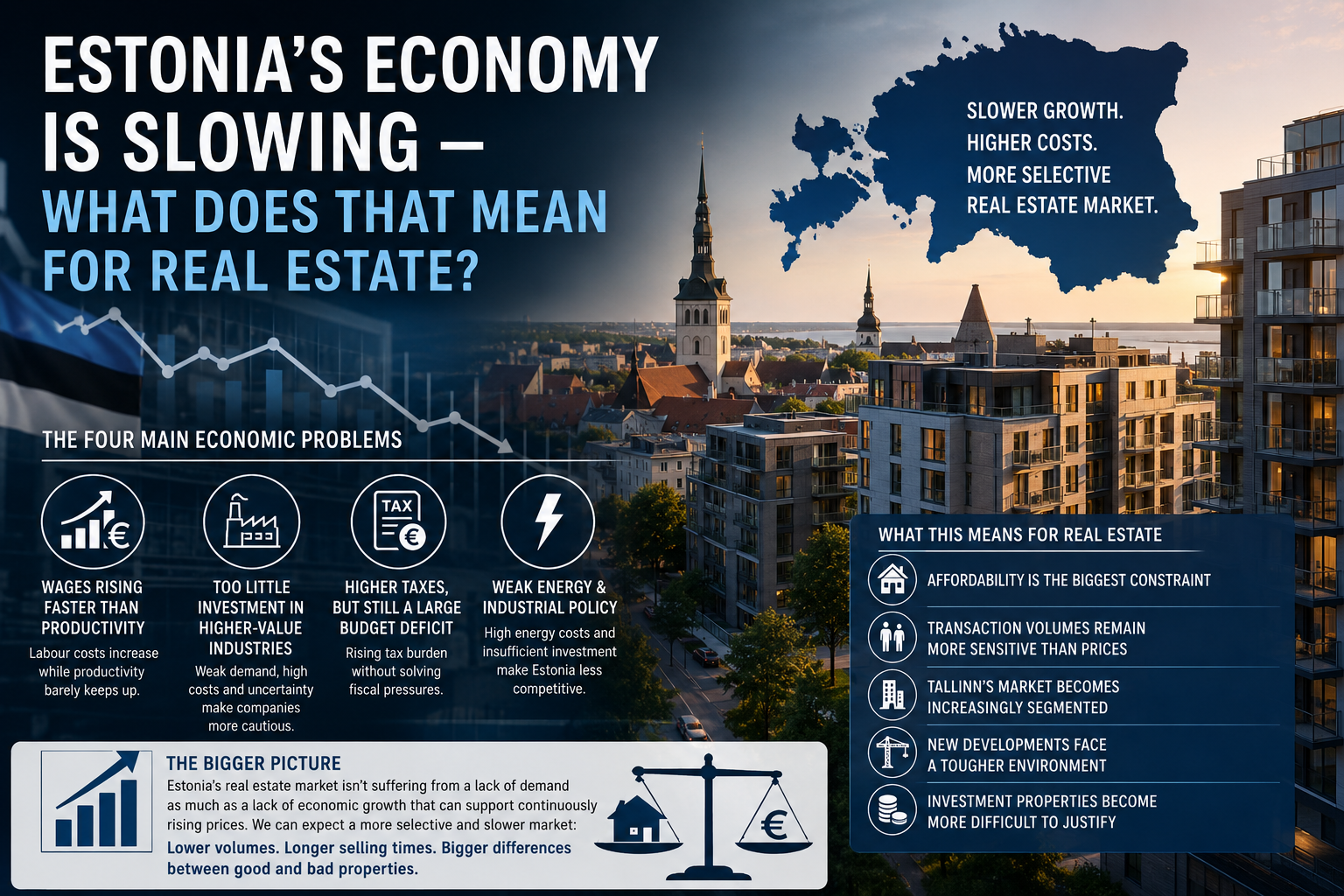
The four main economic problemsWages are rising faster than productivity Labour costs are increasing while productivity is barely keeping up. This makes Estonian companies less competitive, particularly in exports.Too little investment in higher-value industries Estonia is struggling to attract enough capital, skilled labour and investment into more sophisticated manufacturing and technology. Weak external demand, high energy costs and geopolitical uncertainty make companies more cautious.Higher taxes, but still a large budget deficit Estonia is increasingly taxing consumption and labour, while property and wealth remain relatively lightly taxed. The result is a growing tax burden without eliminating the state’s fiscal pressures.Energy and industrial policy remain weak High and volatile energy costs and insufficient investment in energy infrastructure make Estonia less attractive for energy-intensive businesses. At the same time, exports are increasingly dependent on re-exports rather than products with high domestic added value.What does this mean for real estate?The interesting part is that the real estate market hasn’t collapsed despite these economic weaknesses.Estonian housing prices actually increased by 5.2% in 2025, while in Q1 2026 the dwelling price index was another 5.9% higher year-on-year.But the economic problems are influencing how the market behaves:
1. Affordability is becoming the biggest constraint. When wages rise faster than productivity but housing prices and construction costs also rise, affordability doesn’t necessarily improve. Buyers can earn more but still struggle to afford substantially more expensive homes.
2. Transaction volumes remain more sensitive than prices. The OECD notes that Estonia’s housing-market activity recovered in 2025 but transactions remained below the long-term average, with the correction particularly visible in Tallinn.This creates a market where prices can remain relatively strong while buyers become more selective and transactions take longer.
3. Tallinn is likely to become increasingly segmented. Good locations, quality properties and energy-efficient homes should remain relatively resilient. Less attractive properties, properties with high renovation costs or poor energy performance will face greater pressure because buyers have more alternatives and are increasingly calculating the total cost of ownership.
4. New developments face a tougher environment. There is still substantial supply in Tallinn. In Q2 2026, around 3,000 new apartments were being offered, while the average new-development price was around €5,227/m². At the same time, completed unsold inventory had fallen significantly, suggesting that demand exists but developers have to compete for increasingly cautious buyers.
5. Investment property becomes more difficult to justify. If property prices rise faster than rents, yields compress. Combined with taxation, maintenance costs, financing costs and relatively high purchase prices, investors increasingly need to look at actual cash flow and long-term value creation, rather than simply expecting capital appreciation.
The bigger pictureI would summarise the situation like this: Estonia’s real estate market is not suffering from a lack of demand as much as it is suffering from a lack of economic growth capable of supporting continuously rising prices.So I wouldn’t interpret the economic outlook as a prediction of a major property-price crash. The current data doesn’t support that. Instead, it points toward a more selective and slower market.The key question for real estate over the next few years is therefore not simply “Will prices go up or down?”It is:Can Estonian incomes, productivity and economic growth catch up with the cost of owning and developing property?If productivity and economic growth remain weak, I would expect lower transaction volumes, longer selling periods and greater differences between good and bad properties, even if headline prices continue to rise moderately.And this is particularly relevant in Tallinn, where new-development prices remain high and buyers have become much more sensitive to financing and total housing costs.


